
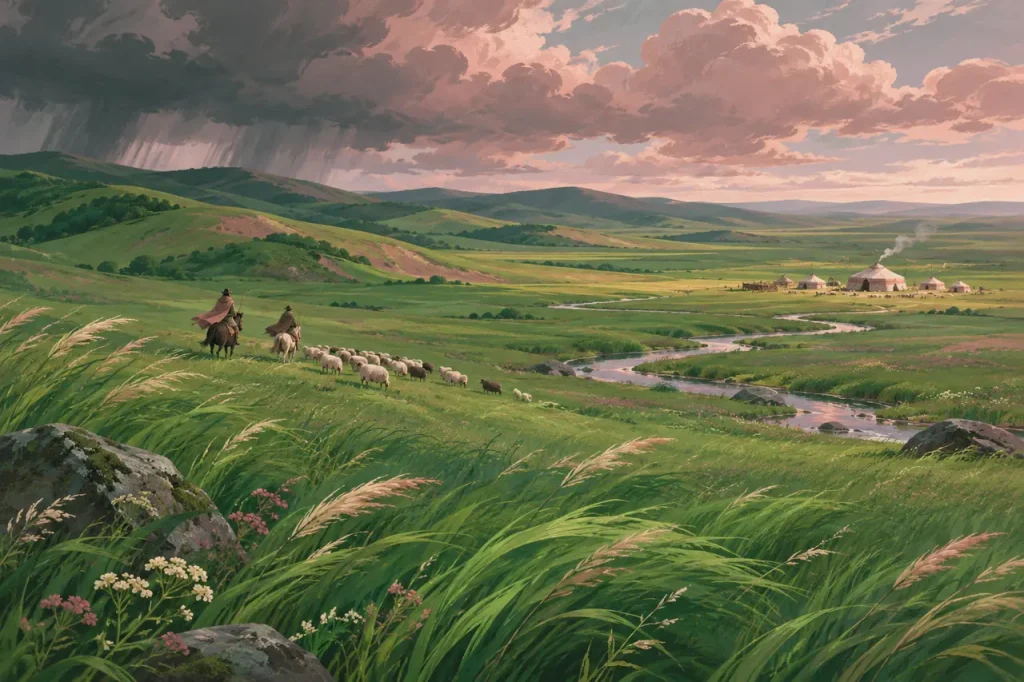
Rainward is a game concept about moving a herd with the rains. The player observes a small steppe landscape, chooses when to leave a pasture and guides animals towards the next workable camp. It is not intended as a race across a huge map. Its central question is whether moving now gives the herd and the land a better chance than staying. A journey matters because it changes both what the animals need and what the pasture can provide.
The shape of a moving day
A day begins with observations around camp. Look at grass height, recent grazing and the condition of the herd. Compare a nearby slope with a more distant patch that has received rain. Choose a route, then guide the animals through the terrain rather than instantly moving a marker on a map. At the next camp, review the outcome and let the landscape’s visible changes inform another plan.
The proposed route system gives streams, ridges and sheltered hollows distinct roles. A shallow crossing can be direct but awkward for a spread-out herd. A ridge offers a good view and poor shelter. A longer hollow can make movement easier while obscuring the distant destination. These relationships should be visible enough to reason about, with additional information available when the player inspects a place.
A herd is more than one marker
The animals are intended to move as a group with internal differences. A tired animal may slow the rear, while a narrow approach can stretch the formation. The design should make those differences understandable without requiring constant individual micromanagement. Broad guidance, sensible regrouping places and clear feedback would matter more than repeatedly issuing tiny corrections to every animal.
There is an important scope limit here. We are not claiming a complete animal-behaviour simulation. The prototype should begin with only the behaviours needed to make route choice meaningful. If a group spreads near water, the player must be able to see why and have a reasonable way to respond. Complexity that produces confusion without a useful decision does not serve the concept.
The rain-shadow valley
The fictional setting follows a valley with exposed upper grasslands, a branching stream and sheltered lower ground. Rain reaches different areas at different times. Fresh growth is therefore an opportunity to interpret rather than a resource that appears everywhere at once. A pasture already used by the herd needs recovery, and a visually green slope may not yet offer the same value as a mature patch.
The art direction combines leaf green, deep green, charcoal and dusty rose earth. Foreground plants establish local condition; broad cloud and terrain shapes establish distance. We want a painterly landscape whose important features survive at small screen sizes. A colour change should be supported by height, texture or shape so that the player does not need to distinguish subtle hues to make a basic decision.
A manageable first journey
An initial prototype would need only a few pastures, one stream crossing and a reason to revisit an earlier camp. Its purpose would be to test whether players can explain the relationship between travel effort and grazing opportunity. We would also examine whether guiding the herd adds understanding, rather than becoming an unrelated movement task between planning screens.
The pasture recovery note explores the timing behind that choice, and the crossing study looks at group movement. Rainward remains a concept without an announced release, public download or supported platform list. Its companion Winter Commons studies shared access to shelter instead of extending this project with every possible social system.