
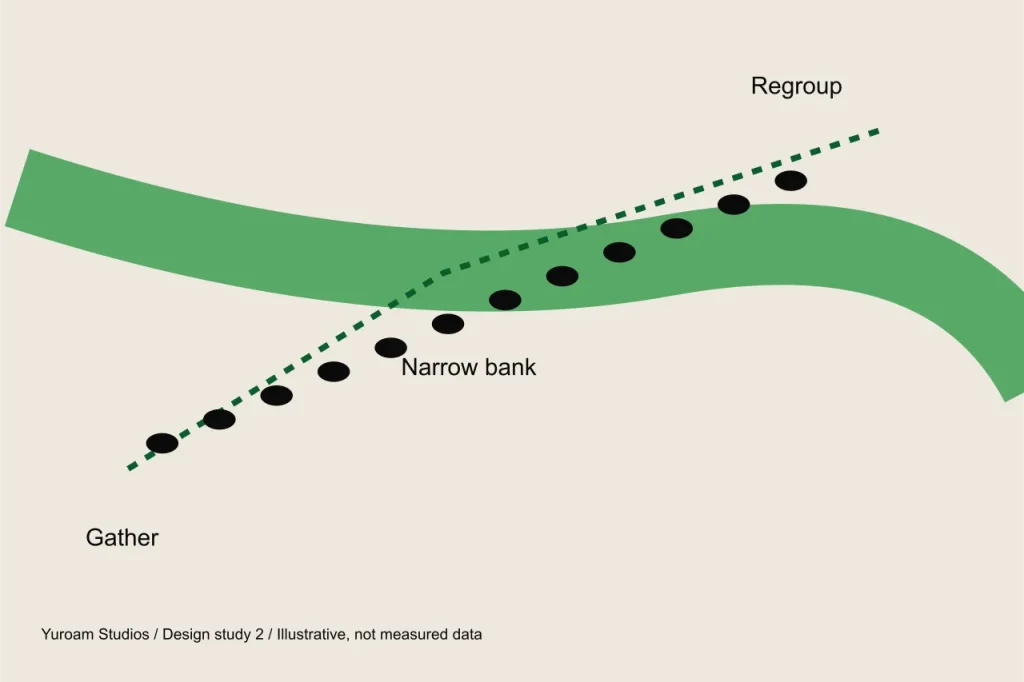
A route drawn as a line hides the shape of the group travelling along it. In Rainward, a herd should not pass through a narrow stream approach as though it were one perfectly responsive marker. The front may reach the water while the rear is still negotiating a slope. That difference can make movement meaningful, but only if the player can understand and influence it without issuing constant individual commands.
Begin before the water
The proposed crossing scene includes an open approach, a narrow bank and a broad exit. The approach gives the herd room to gather. The bank compresses its shape. The exit provides a place to regroup before the next climb. Removing any of these parts changes the experience, even if the stream itself remains identical. This is why route design needs to consider more than the obstacle at its centre.
A player should be able to inspect the crossing from a nearby rise. The view needs to show where the group will narrow and where it can recover its shape. If the exit is hidden until the animals are already committed, an important part of the decision becomes unavailable. Some uncertainty is reasonable, but it should concern a specific condition rather than basic geography that the camera simply refuses to reveal.
Guidance at the scale of a group
The intended controls favour broad guidance: choose an approach, set a direction and use a regrouping place. Individual animals may respond differently, but the player should not need to click each one to complete an ordinary journey. A slow rear should be visible as a change in formation, with a clear opportunity to pause or adjust the route. The game should explain the cause before asking for a response.
This is a deliberately scoped behaviour model. We are not promising a comprehensive simulation of animal cognition. The prototype only needs enough variation to make the terrain matter. If animals spread near a wide bank, the player can recognise the space that caused it. If a narrow approach slows the group, the formation should show that constraint. Random motion that cannot be interpreted would add activity without adding understanding.
Compare two routes honestly
Imagine a direct crossing with a difficult approach and a longer route with a broad, shallow bank. The direct route should save something real, such as travel distance, while asking for more careful group management. The longer route should offer a visible benefit rather than being an obviously inferior option. The herd’s condition can change which trade-off is attractive on a particular day.
The interface should avoid collapsing those differences into a single route rating. A simple route note can name the narrow approach, the available shelter and the approximate distance. The player then connects those facts to the current journey. This preserves the relationship between planning and movement: the reason for choosing a route should be recognisable while actually using it.
Recovery is part of the design
A crossing mistake should offer a manageable response. If the group becomes too spread out, a nearby open area can allow regrouping. If the player chooses a poor approach, backing away should be possible before the entire herd is committed. Such recovery does not remove consequences. It gives the player a way to learn from them without turning a small judgement into a confusing dead end.
For a future evaluation, we would ask whether someone can identify the front, middle and rear of the herd during the difficult moment, then describe which terrain feature affected each part. The pasture note explains why reaching fresh ground may justify that effort. The Rainward overview places the crossing inside a larger seasonal loop. The useful outcome is a journey that feels shaped by the herd, rather than a map line decorated with moving animals.