
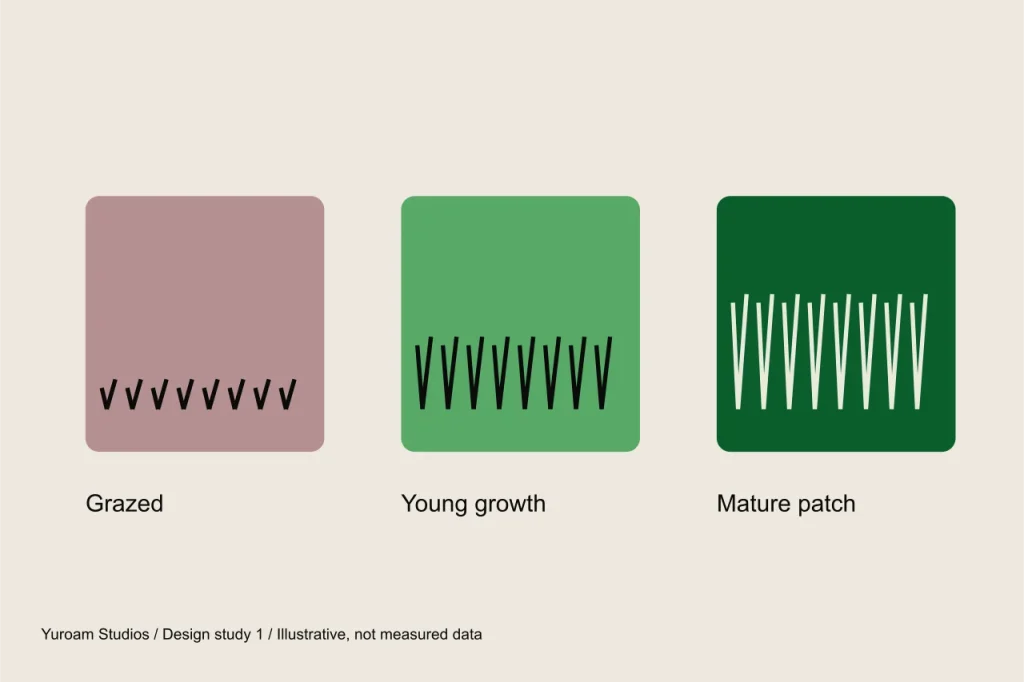
Rain is an invitation to look again, not an instruction to move immediately. In the Rainward concept, a newly green slope should create a question about timing. If every shower instantly produces a full pasture, following the weather becomes a simple chase. If recovery happens through invisible numbers, the landscape stops helping the player. We want the period between rainfall and useful grazing to be readable enough that waiting, moving and returning can each make sense.
Three conditions worth distinguishing
A proposed pasture study begins with recently grazed ground, young growth and a mature patch. These are design states rather than claims about a complete ecological model. Recently grazed ground has a recognisable pattern of short plants and exposed soil. Young growth brings a different texture without immediately promising the same benefit as mature grass. A fuller patch offers a clearer opportunity, but the route towards it may still be demanding.
The states need to remain distinct when viewed from normal play distance. Tiny leaf detail is unlikely to carry the difference. Height, density and the distribution of bare ground can do more useful work. Colour supports those cues, yet a greyscale view should still convey a change. This is particularly important when the scene is seen on a small display or under lighting that makes several greens look similar.
Put travel effort beside the opportunity
The value of a pasture depends on more than its condition. Consider a nearby patch that is still recovering and a distant mature slope across a stream. Moving to the distant slope may provide more grazing, but the journey uses time and asks more of tired animals. Remaining nearby may allow the herd to recover while limiting how much pressure can be placed on the ground. A useful choice needs both sides of that comparison to be visible.
We would avoid presenting a single score that automatically ranks the destinations. A summary can show observed grass condition, route features and uncertainty, leaving the player to relate them to the herd’s current needs. The information should be plain enough to explain aloud. If someone cannot say why a distant patch is attractive or difficult, the interface is not yet supporting a decision.
Returning should reveal a history
A seasonal route becomes more interesting when the herd revisits land it has already used. The player can compare the current scene with an earlier memory: a bare area has filled in, a frequently used approach remains worn, or a sheltered corner has changed differently from an exposed slope. Those changes make the route feel consequential. They also give a reason to record observations instead of treating every destination as new.
The concept should not require perfect memory. A camp note can show what was observed and when, while making clear that it is an observation rather than a live measurement. A small sketch or plain description may be enough. The player should still look at the actual pasture on arrival, because the purpose of the record is to support attention, not replace it with a remote dashboard.
A small seasonal experiment
The first useful prototype could contain three patches and a single return loop. One patch recovers while another is used, and a route constraint makes timing matter. We would examine whether players notice the recovery, connect it to their earlier visit and use that knowledge when planning. More weather states would be premature if those basic relationships remain unclear.
This note connects to Rainward’s movement loop and to the herd-crossing study, where the cost of reaching a pasture becomes physical. The proposed recovery system is intentionally limited. It exists to create understandable decisions about a fictional steppe, not to claim scientific authority. A successful scene would let a player look at green ground and ask a more useful question: is this the right place for the herd now?