
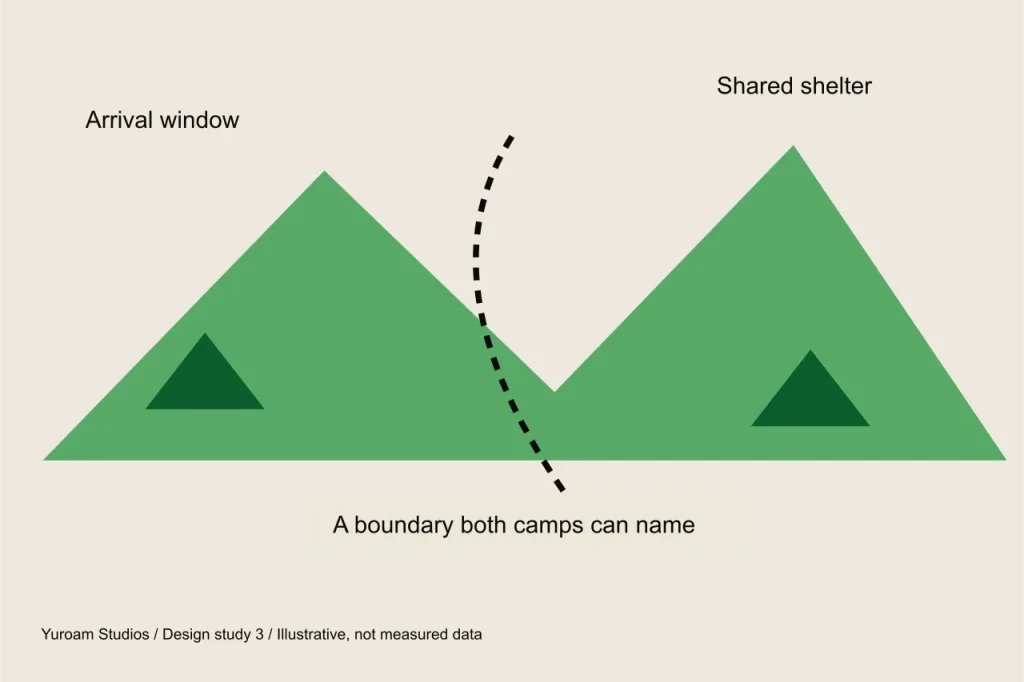
An agreement is difficult to follow when its terms mean different things to the people using it. Winter Commons begins from that problem. A conversation about grazing rights should produce something the player can recognise in the valley: where access begins, when it applies and what responsibility comes with it. If the agreement only changes an invisible relationship meter, the land and the negotiation become separate games that happen to share a screen.
Name a place, then name a condition
A proposed first agreement concerns a sheltered slope beside a stream bend. The bend gives both camps a visible boundary. Access begins after another herd has left, and the arriving group agrees to keep a shared approach clear. Each term corresponds to something that can be observed. The language should remain concise enough that the player can remember its purpose without memorising a long legal document.
Precision does not require obscure wording. “The slope above the marked bend” is useful only if the mark and slope are identifiable from both approaches. A term such as “until the pasture is ready” needs an agreed meaning rather than a hidden threshold. The concept should help the player ask for clarification before accepting a proposal, because uncertainty in the wording is itself a practical problem worth resolving.
Needs before personalities
Negotiation can become shallow when every character is reduced to a predictable preference. A more useful starting point is a concrete need. One camp has animals that need a short route to water. Another can wait but needs shelter later. These conditions create room for different arrangements without requiring a catalogue of personality tricks. The player can reason about what an exchange changes for each group.
This does not mean every proposal should be accepted if the arithmetic balances. Reliability, earlier commitments and uncertainty can matter, but they need visible context. A group may resist a late arrival because it conflicts with an existing arrangement, not because a hidden dialogue score is too low. The intended feedback should explain the conflict in terms that suggest a possible revision.
Review terms on the ground
After a conversation, the player should be able to travel through the agreed area and see the arrangement’s consequences. Which approach remains shared? Where can the herd pause? What place is reserved for another arrival? A compact record can support that observation, but the world should not require constant reference to an abstract boundary overlay. Shared landmarks give written terms a physical anchor.
The design becomes more interesting when conditions change. A difficult crossing might make the original route impractical. The next discussion then has a clear subject: adjust the access time, use a different approach or exchange responsibility for maintenance. A revision should leave a readable history, so the player can distinguish the current agreement from an older version. Silent changes would undermine trust in the system.
Avoid a perfect-conversation puzzle
There should be room for an arrangement that is workable but incomplete. Solving water access may leave a longer journey to shelter. That compromise can be worth accepting if the alternatives are worse. The game should not imply that every situation has one ideal sentence that unlocks all benefits. The meaningful question is which consequence the player is prepared to live with and how they will respond later.
The first prototype would use one valley, a small number of needs and a single event that prompts review. We would examine whether a player can explain the terms before leaving camp and identify them afterwards. Winter Commons describes the broader concept, while the landscape note considers how boundaries remain visible. These fictional agreements are game design proposals, not claims about the laws or traditions of a real community.